Monday · Open until 8 p.m. · Iberville and Saint-Jean
FrançaisImplant-supported dentures: types, placement and maintenance


Implant-supported prostheses address a problem that traditional dentures do not solve: prostheses that move as soon as you eat or speak. An implant-supported denture is a dental prosthesis anchored on implants inserted into the jawbone , rather than sitting on the gum, making it a stable replacement for missing teeth. This guide covers the types offered, the application, the placement steps, maintenance and costs in Quebec.
What is an implant prosthesis?
An implant-supported prosthesis is used to replace one or more missing teeth by relying on implants screwed into the bone, and not on the gum or on neighbouring teeth. The prosthesis is fixed or clipped onto these anchors , so it holds in place during meals instead of straining the rest of the teeth.
How dental implants support the prosthesis
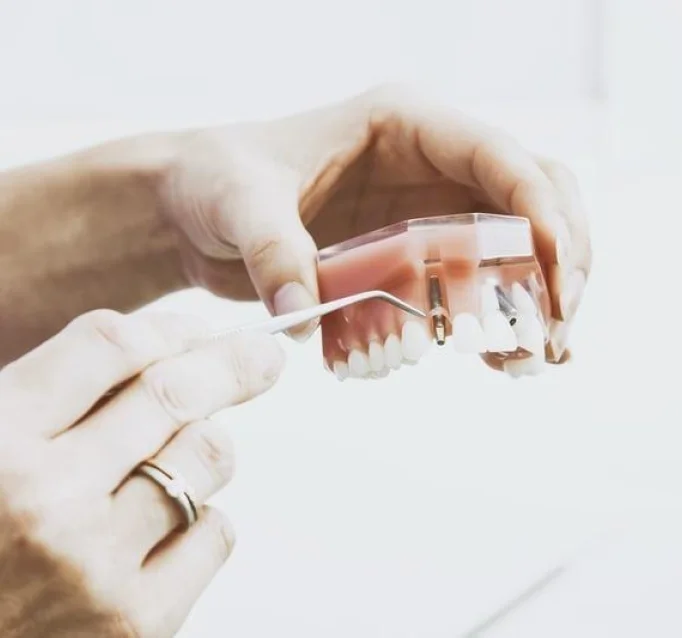
Dental implants act as artificial roots . These are small titanium screws inserted into the jaw bone; the dentist then attaches an abutment, the piece that passes through the gum and serves as the base of the prosthesis.
Between placement and the final prosthesis, the bone fuses to the surface of the implant, a phenomenon called osseointegration , and it is this bone fusion that allows dental implants to support chewing year after year.
Difference between an implant-supported prosthesis and a conventional removable prosthesis
The conventional removable complete prosthesis rests on the gum and is held by a simple suction effect, while a implant-supported prosthesis is retained by anchors fixed in the bone. This difference in retention is especially felt when chewing, because a denture can move with firm food while the anchored version maintains its stability .
Daily comfort follows the same logic: a prosthesis that does not rub the gum causes fewer pressure points.
The long-term effect also matters. A denture placed on the gum does not slow down bone loss under the prosthesis, while the implants continue to stress the bone with each bite. This mechanism explains why the formula is available today in several types, both fixed and removable.
What types of implant-supported prostheses exist?
Implant-supported prostheses are divided into 2 large families: fixed models, which only the dentist removes, and removable models, which the patient detaches themselves. The choice between a fixed or removable prosthesis depends on the number of teeth to be replaced, the budget and the type of anchor used, and 4 options come up most often in clinics.
These 4 options are distinguished by their mode of anchoring and the situation they target. The fixed implant-supported prosthesis, screwed or sealed on the abutments, is suitable for a complete arch to be restored. The removable prosthesis on a retention bar clips onto a bar connecting the implants and is removed every day, also for a complete arch. The removable prosthesis on snaps is anchored by clips clipped to the implants, a simpler assembly that requires fewer implants. The fixed single implant crown is screwed or cemented onto a single implant to replace a single tooth.
Fixed implant-supported prosthesis
The fixed implant-supported prosthesis is screwed or sealed on the abutments, so it remains in the mouth permanently and only the dentist can remove it during an appointment. A full arch generally relies on 4 to 6 implants distributed to distribute chewing forces.
Maintenance is similar to that of natural teeth, with daily brushing and careful cleaning under the fixed prosthesis.
Removable implant-supported prosthesis with retention bar
Compared to the fixed prosthesis, this option can be removed every day. A metal bar connects the implants together and the removable prosthesis clips onto it, which distributes the retention across the entire arch rather than just one point.
The gain in stability compared to traditional dentures is noticeable from the first meals, and removal facilitates cleaning of the bar as well as the gums.
Removable implant-supported prosthesis with snap buttons
Snap-type fasteners hold the prosthesis on 2 or more implants, so the number of implants to place decreases and the bill follows. This assembly, however, requires closer monitoring : the fasteners wear out from clipping and unclipping, and they must be replaced periodically to maintain the same comfort. Daily maintenance is similar to that of a prosthesis on a bar, and the base remains tailor-made for the arch.
Single crown on implant
When a single tooth is missing in an otherwise healthy mouth, the implant-supported single crown avoids cutting into the enamel of neighbouring teeth to place a bridge. This option targets isolated missing teeth, not the rehabilitation of an entire arch.
The replacement then involves 2 parts, the artificial root and the visible part, and the aesthetic result blends into the smile because the dental crown is tinted according to the remaining teeth. It remains to be seen whether the mouth can receive implants, a question that will be decided in the clinic.
Who is a candidate for an implant-supported prosthesis?
An implant-supported prosthesis is not suitable for all mouths, and eligibility is checked in the clinic before starting treatment. 3 elements weigh in the balance: the quantity of bone available, the health of the gums and the extent of the teeth to be replaced.
Bone density and gum health
Bone volume is the first requirement to meet, because the jaw bone must be thick and dense enough to hold the implant still during healing. A digital x-ray or 3D scan measures bone density before even discussing the type of prosthesis.
Gum health is just as important. An inflamed gum or affected by periodontitis weakens the anchorage, so tissue treatment precedes the placement until the mouth becomes healthy again.
Partial edentulism or complete edentulism
Replacing 1 or 2 missing teeth and rehabilitating a complete arch do not require the same assembly. In the first case, the crown or small bridge on implants is integrated into a still functional dentition and restores the balance of the mouth without affecting the rest.
Complete edentulism is a game changer. There are no more neighbouring teeth to preserve, so the choice is between the fixed prosthesis and the removable versions described above.
Is a bone graft required before placement?
When the bone volume is insufficient, a bone graft reconstructs the site before placing the implants. The graft needs time to consolidate, which prolongs the treatment.
This additional step is not exceptional, since bone loss naturally follows tooth loss, especially when dentures have rested on the gums for years. The dentist decides on a case-by-case basis, and once eligibility is confirmed, treatment follows a well-defined sequence.
How is the placement of a implant-supported prosthesis carried out?
The placement of a implant-supported prosthesis is spread over several appointments rather than a single visit, because the bone needs time between surgery and the final prosthesis. From planning in the clinic to final adjustment, 4 stages punctuate the treatment.
Consultation and digital planning
Planning treatment begins in the clinic, with digital x-rays, a 3D scan and a complete dental exam of the teeth and gums. From these images, the dentist virtually positions each implant and builds a tailor-made plan before any intervention.
The initial consultation is free of charge for restorative treatments, which allows the planned care and budget to be validated before committing.
Implant placement surgery
The implants are inserted into the jawbone under local anaesthesia, through a small opening made in the gum. Bone healing begins as soon as the tissues are closed.
The number of implants depends on the arch to be restored and the type of prosthesis chosen, so the price of a dental implant multiplies quickly when it is necessary to support an entire arch rather than a single tooth.
Osseointegration and temporary prosthesis
The implant fuses with the bone during the weeks following surgery, so no permanent prosthesis can be screwed onto it until bone union is complete. A temporary prosthesis takes over during this time and maintains the masticatory function as well as the aesthetics.
Its comfort does not match that of the final model, but it avoids living for months with visible space.
Placement of the definitive prosthesis
Once the bone has consolidated, the definitive prosthesis is fixed on the abutments , then the occlusion is adjusted tooth by tooth until chewing is done without pressure points. Each piece is made to measure, according to the shape of the face and the shade of the remaining teeth.
A final appointment validates daily comfort and the appearance of the smile, and it is from there that the benefits are measured meal after meal.
Advantages of an implant-supported prosthesis for chewing and comfort
Prostheses on implants provide advantages which are mainly verified with use, without necessarily reproducing 100% of natural teeth. 3 gains come up most often: stability during chewing, preservation of bone and a discreet aesthetic result that simplifies everyday life.
Stability and masticatory function
Unlike dentures placed on the gum, the prosthesis anchored on implants does not move when you bite into a firm food, because the forces pass through the anchors rather than through the soft tissues. This stability brings the masticatory function closer to that of complete teeth.
Speaking also becomes more relaxed, since nothing risks falling apart in the middle of a conversation.
Preservation of the jaw bone
The bone needs to be stressed to maintain itself, so each bite transmitted by the implants slows down the bone resorption that follows tooth loss. A denture rests on the gum and allows the bone to retract year after year.
This replacement of the roots also protects the health of the remaining teeth and the support of the tissues, which sag when the jawbone resorbs.
Natural aesthetics and everyday confidence
The aesthetics of an implant prosthesis is based on custom-made artificial teeth, whose shape, alignment and colour reproduce natural teeth. The laboratory works from digital impressions and photos of the smile.
The result remains discreet, and this is often what people notice the most: laughing or speaking without monitoring your prosthesis changes the daily situation. This assurance, however, depends on regular maintenance.
Maintenance and lifespan of an implant-supported prosthesis
Maintaining an implant prosthesis is based on 2 things: rigorous daily hygiene and follow-up care at regular intervals. This constant cleaning protects the health of the gums around the anchors, so it directly affects the longevity of the prosthesis.
Cleaning a fixed implant-supported prosthesis
Cleaning a fixed prosthesis requires brushing morning and evening, as with natural teeth, then going under the prosthesis where plaque accumulates without being seen. A suitable interdental floss, superfloss or water flosser joins this space between the prosthesis and the gum, the one that the brush misses.
The area under the prosthesis is the critical point : inflammation that develops around an implant threatens the anchorage, and not just the tissues. Professional scaling therefore complements home care when the dentist recommends it.
Cleaning a removable implant-supported prosthesis
Unlike the fixed prosthesis, the removable prosthesis is removed every evening to be brushed with lukewarm water with a mild soap or a denture cleaner, never with an abrasive toothpaste. Implants and brackets are brushed separately, just like teeth.
This 2-step cleaning has an advantage: the base of the prosthesis becomes accessible, and the residue lodged in its hollows is removed by brushing or soaking. This is where the maintenance of a removable model becomes simpler compared to a screwed model.
Clinical follow-ups and replacement of brackets
When the attachments or the bar lose their retention, the prosthesis begins to move and a follow-up appointment allows the worn parts to be replaced. This replacement of brackets is a common operation , not a sign of implant failure.
The follow-ups are also used to check the condition of the anchors, the wear of the artificial teeth and the stability of the whole. Properly monitored, an implant-supported prosthesis lasts for many years, even if its wearing parts are replaced along the way. It remains to quantify the initial investment.
How much does a implant-supported prosthesis cost in Quebec?
The price of a implant-supported prosthesis is between $10,000 and $30,000 per arch in Quebec, according to the price of dental prostheses published for complete rehabilitation. Three factors explain such a wide gap: how many implants must be placed, the model chosen (fixed or removable) and the complexity of the file, for example when a bone graft is added to the process. A detailed care plan, provided after the assessment appointment, remains the only way to obtain a fair amount for your own situation.
On the payment side, Flexiti financing at 0% interest allows you to spread the bill, and the Canadian Dental Care Plan is accepted as assistance for eligible people.
Plan your implant-supported prosthesis at Votre Dentisterie
Votre Dentisterie supports patients who are considering an implant-supported prosthesis in its 2 clinics in the Iberville and Saint-Jean sectors. Dr. Duy K. Nguyen has completed several training courses in implantology, evening appointments are offered and care is given without judgment , regardless of the current state of the teeth or the time elapsed since the last visit. Call 450-305-6505 or make an appointment online for a free initial consultation.
Frequently asked questions about implant-supported prostheses
Does an implant prosthesis hurt?
A implant-supported prosthesis is placed under local anaesthesia, so the surgery itself is not felt. Tenderness and swelling tend to appear in the days that follow, and they can be managed with the postoperative recommendations given at the appointment.
How long does the complete treatment take?
The duration depends mainly on osseointegration, or the period it takes for the bone to fuse to the implants. When a bone graft is added to the file, one more healing stage precedes the placement of the definitive prosthesis.
Can you eat normally with a implant-supported prosthesis?
Masticatory function largely returns, because the forces pass through the anchorages rather than through the gum. A fixed model comes closest to a normal diet, while with a removable model held in place by ties, some very hard or sticky foods should still be avoided.
How long does an implant-supported prosthesis last?
Longevity depends primarily on daily hygiene and regular follow-ups, since the tissues around the implants react quickly to plaque accumulation. Well maintained, it will serve many years.
Does the CDCP or insurance cover a implant-supported prosthesis?
Coverage varies depending on the plan and each person's eligibility, and many private insurance plans only reimburse part of it. Votre Dentisterie accepts the Canadian Dental Care Plan as assistance for eligible individuals and offers Flexiti financing at 0% interest to cover the rest.
Other articles

Temps de guérison d'un implant dentaire : de la pose à la couronne
Read the article
Implant dentaire ou couronne : comment faire le bon choix?
Read the article
Aligneurs ou broches en orthodontie : lequel choisir?
Read the article
Canadian Dental Care Plan: eligibility, covered services and enrolment
Read the article
Get started today. Pay at your own pace.
With Dentoplan, get a plan adapted to your situation. Rapid approval, directly in the clinic.