Monday · Open until 8 p.m. · Iberville and Saint-Jean
FrançaisDental filling costs in Quebec in 2026

The price of a dental filling is between $126 and $560 per tooth in 2026, depending on the number of surfaces to be restored and the material used. The lowest amount corresponds to an amalgam on a single surface of a molar (code 21221, $126) and the highest to a composite on five surfaces of a molar (code 23225, $560). Each procedure has its own billing code, which allows you to validate each line of your invoice.
The number of filled surfaces provides the most reliable benchmark for estimating your bill, because each surface corresponds to a separate procedure code.

Price per tooth for a composite filling on a molar, depending on the number of surfaces treated:
- 1 surface (code 23221) : $219, for a small cavity on one side.
- 2 surfaces (code 23222) : $327, for more extensive decay.
- 3 surfaces (code 23223) : $396, for a cavity that goes around the tooth.
- 4 surfaces (code 23224) : $465, for a large restoration.
- 5 surfaces (code 23225) : $560, for a largely reconstructed tooth.
These amounts remain benchmarks: an examination in one of our 2 clinics specifies the real price depending on your situation.
What is the average price of a filling depending on the number of surfaces?
The number of surfaces affected on a tooth guides the price of a filling: each additional surface corresponds to a different billing code, with its own price. The position of the tooth also matters, since the price of a molar is not that of a premolar or an anterior tooth.
Single-surface fillings
A single-surface filling corresponds to a small cavity that affects only one side of the tooth. This is the most affordable option and the most common situation when a cavity is detected early:
Composite, anterior tooth, classes I, V and VI, code 23111: $179
Composite, premolar, one surface, code 23211: $196
Composite, molar, one surface, code 23221: $219
Amalgam, molar, one surface, code 21221: $126
We always favor this type of simple intervention when the condition of the tooth allows it.
Fillings on two or three surfaces
When the decay affects two or three sides of the tooth, the restoration requires more material and precision, and the price follows:
Composite, premolar, two surfaces, code 23212: $305 / three surfaces, code 23213: $350
Composite, molar, two surfaces, code 23222: $327 / three surfaces, code 23223: $396
Amalgam, molar, two surfaces, code 21222: $217 / three surfaces, code 21223: $282
Composite, anterior tooth, class III, code 23112: $200 / class IV, code 23113: $334
This situation remains very common among adults who consult for a more advanced cavity.
Complex or multi-tooth filling
For a very damaged tooth, the filling reaches the top of the range:
Composite, premolar, four surfaces, code 23214: $434 / five surfaces, code 23215: $486
Composite, molar, four surfaces, code 23224: $465 / five surfaces, code 23225: $560
Beyond this point, rebuilding the tooth with a filling is no longer always the right decision, and a crown often becomes the more durable choice. An intervention of this magnitude requires planning: we establish a clear treatment plan and, when possible, we spread out the care to respect your budget.
Filling in children
On a primary tooth, prices are lower because the tooth is smaller and the treatment is shorter:
Composite, primary posterior, one surface, code 23411: $141
Two surfaces, code 23412: $231
Three surfaces, code 23413: $289
The number of surfaces determines the extent of the treatment, but the material chosen also influences the final amount.
What is the price difference between a white filling and a grey filling?
Beyond the number of surfaces, the material chosen creates the main price difference between white filling and grey filling. Color is not just a question of appearance: it reflects two families of materials with different costs and durations.
Comparison of filling types, price per tooth, aesthetics and lifespan:
- White (composite), permanent tooth (codes 23111 to 23113, 23211 to 23215, 23221 to 23225) : from $179 to $560 per tooth, natural colour, lifespan of 5 to 10 years.
- Grey (amalgam), permanent tooth (codes 21212, 21221 to 21223) : from $126 to $282 per tooth, visible metal, lifespan of 10 to 15 years.
- Ceramic crown, when the tooth is too damaged (code 27200) : $1,349 per tooth plus laboratory fees, very natural appearance, lifespan of 15 years or more.
White composite fillings
White fillings are made of composite, a resin that is tinted to blend into the tooth enamel. This is the option that we offer most often, because it remains discreet, both on a visible tooth and on a molar. Our pricing ranges from $179 for one surface on an anterior tooth (code 23111) to $560 for five surfaces on a molar (code 23225).
Grey amalgam filling
The grey amalgam filling remains solid and economical, from $126 for one surface on a molar (code 21221) to $282 for three surfaces (code 21223), but we are placing it less and less. This metal contains mercury and is being phased out internationally under the Minamata Convention on Mercury, in favor of metal-free materials. In the mouth, its dark colour also makes it more visible than composite.
For the same surface area on a molar, the difference between the two materials is not marginal: $126 for amalgam versus $219 for composite for a single surface, or approximately 74% more.
When filling is no longer enough: inlay and crown
When a large portion of the tooth needs to be reconstructed, a ceramic inlay or crown becomes the most appropriate type of restoration. These restorations are custom-made in the laboratory, which explains a higher price: the ceramic or zirconia crown (code 27200) is $1,349, plus laboratory fees. When the tooth must first be reconstructed to seat the crown, the reconstruction (code 29600) adds up to $279. For an inlay, ask for an estimate in the clinic: the amount depends on the laboratory and the material chosen.
The material accounts for part of the price, but it is the examination of your case which determines the final amount.
What are the factors that vary the cost of a filling?
Beyond the number of surfaces and the material, the cost of a filling depends on your clinical situation. Each case is unique, and three elements above all guide the final amount.
The extent and depth of decay
The more extensive a cavity is, the more the number of surfaces billed increases, and the price follows code by code: from one surface (code 23221, $219) to five surfaces (code 23225, $560) on the same molar, the difference exceeds $300. A cavity that approaches the nerve may require further care. It is often the extent of the damage, more than the tooth itself, that drives up the bill.
The tooth to be treated
The tooth to be treated also plays a role, and the code grid reflects this: for the same number of surfaces, a molar costs more than a premolar, which costs more than an anterior tooth. On a molar heavily used by chewing, we favor solidity, while on a visible tooth, the natural colour of the composite becomes a priority.
Clinical diagnosis
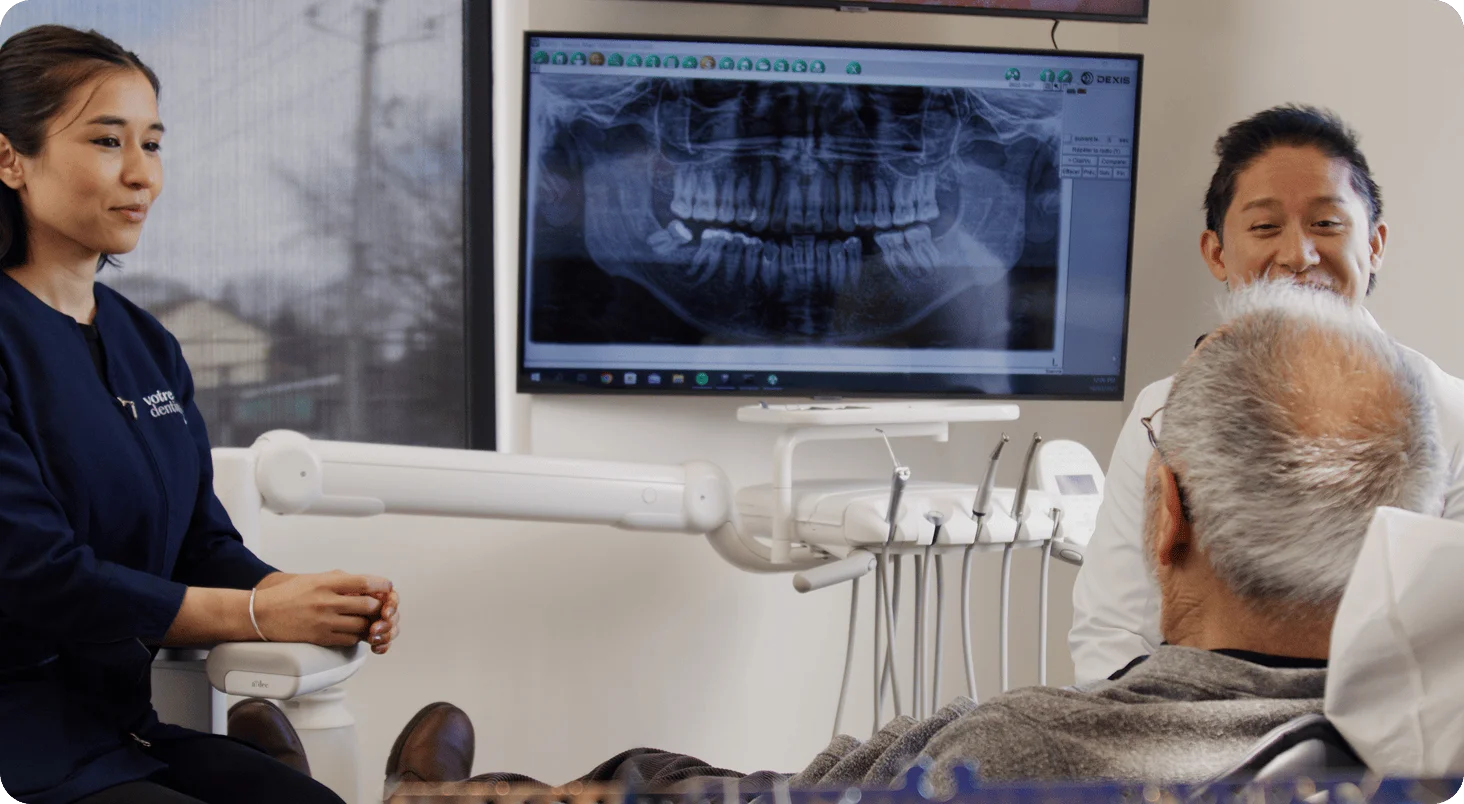
Only a clinical diagnosis allows the cost of a filling to be determined precisely. In our 2 clinics in Iberville and Saint-Jean, a dental examination with digital x-ray allows the dentist to measure the exact extent of the decay. Good to know: intraoral x-rays and photographs are included in the price of the complete oral examination (code 01130, $127 to $211) and the preventive oral examination (code 01200, $68 to $126). You leave with a clear estimate, adapted to your mouth, rather than a simple general range.
Once the price is established, the question is what your insurance or the Canadian Dental Care Plan can cover.
Does insurance cover the cost of a filling?
Good news: a filling is a curative treatment, often covered in part by insurance or by the Canadian Dental Care Plan. With us, we help you see things clearly, without judgment, so that the cost is never a barrier to your health.
The Canadian Dental Care Plan (CDCP) and fillings
The Canadian Dental Care Plan, or CDCP, is the federal plan that reimburses part of the dental care of households without private insurance. We accept it in our two clinics in Iberville and Saint-Jean.
Who is eligible for CDCP
Four conditions must be met at the same time:
Not having access to private dental insurance, whether through employment, a pension plan, a professional association or an individually purchased contract.
Have an adjusted net family income of less than $90,000.
Have filed their income tax return in Canada, as well as their spouse or common-law partner if applicable.
Be a resident of Canada for tax purposes.
Eligibility is confirmed each year: income and the absence of private insurance are revalidated at renewal.
How much does CDCP pay for a filling?
The plan reimburses according to its own rate schedule, separate from our prices. Here are the amounts payable to the general dentist for fillings in 2026:
Composites on anterior teeth (front teeth)
- Classes I, V, VI (code 23111): $179, including $137.70 covered by the CDCP
- Class III (code 23112): $200, including $153.85 covered
- Class IV (code 23113): $334, including $256.70 covered
Composites on premolars
- 1 surface (code 23211): $196, including $150.45 covered
- 2 surfaces (code 23212): $305, including $234.60 covered
- 3 surfaces (code 23213): $350, including $269.45 covered
- 4 surfaces (code 23214): $434, including $334.05 covered
- 5 surfaces (code 23215): $486, including $373.15 covered
Composites on molars
- 1 surface (code 23221): $219, including $169.15 covered
- 2 surfaces (code 23222): $327, including $251.60 covered
- 3 surfaces (code 23223): $396, including $303.45 covered
- 4 surfaces (code 23224): $465, including $358.70 covered
- 5 surfaces (code 23225): $560, including $430.10 covered
Amalgams (grey fillings)
- Anterior or premolar, 2 surfaces (code 21212): $192, including $147.90 covered
- Molar, 1 surface (code 21221): $126, including $96.90 covered
- Molar, 2 surfaces (code 21222): $217, including $165.75 covered
- Molar, 3 surfaces (code 21223): $282, including $216.75 covered
Composites on posterior primary teeth (milk teeth)
- 1 surface (code 23411): $141, including $107.95 covered
- 2 surfaces (code 23412): $231, including $177.65 covered
- 3 surfaces (code 23413): $289, including $221.85 covered
Across the board, the CDCP grid pays about 77% of our price. Three useful details:
The limit is one filling per surface, per tooth, per 24 month period , and this limit is shared among all amalgam, composite and prefabricated restoration codes. In other words, a restored amalgam surface blocks the composite on this same surface for 24 months.
No prior authorization is required for a filling. Restoration codes are part of nomenclature A, which is billed directly, unlike crowns or root canal treatments.
An exclusion to be aware of: a restoration carried out for incisal wear affecting enamel and dentin is not eligible for the plan. Primary incisor teeth are only eligible for children under 5 years of age.
What remains your responsibility
The CDCP does not always reimburse 100% of its own amount: the part paid depends on the adjusted net family income. Here is what it actually looks like for a composite of two surfaces on a molar (code 23222), billed $306 to a patient covered by the CDCP, for an amount payable to the plan of $251.60.
The part paid by the CDCP and the amount that remains your responsibility varies according to the adjusted net family income:
- Less than $70,000 : CDCP pays 100% of the covered portion, i.e. $251.60 paid, and $54.40 remains your responsibility.
- From $70,000 to $79,999 : CDCP pays 60%, or $150.96 paid, and $155.04 remains your responsibility.
- From $80,000 to $89,999 : CDCP pays 40%, or $100.64 paid, and $205.36 remains your responsibility.
Please note: even at 100% coverage, a balance of $54.40 remains, because the amount payable by the CDCP is lower than our rate for this procedure.
Two differences therefore accumulate: the share linked to income, and the difference between the dentist's fees and the amount provided for in the grid. This is why we give you a written estimate before starting, with the CDCP portion and the balance clearly separated.
How to join
The request is made to the Government of Canada, online or by telephone. Once the application is approved, Sun Life administers the plan and issues a membership card with the coverage start date. Present it at reception at your first appointment: we bill the plan directly, you only advance the balance.
Private dental insurance
If you have private dental insurance, the filling is generally reimbursed in part, like any necessary treatment. Your contract may provide for an annual cap or a specific percentage, so check your conditions with us or your insurer. We are happy to fill out the forms to simplify the process for you. Note that having access to private insurance makes you ineligible for CDCP: the two are not cumulative.
Financing without insurance
Without insurance, a financing plan allows you to spread the costs over several months. At Votre Dentisterie, Dentoplan allows you to obtain a plan adapted to your situation, with approval in just a few minutes, directly in the clinic, without complicated paperwork. We give you a clear estimate before any treatment, so you can decide with complete peace of mind.
Covered or not, a filling always costs less than a cavity that is allowed to get worse.
How much does an untreated cavity cost compared to the cost of a filling?
Delaying treatment for a cavity almost always ends up costing more than a simple filling. Caries is very common: according to Statistics Canada, 93% of adults aged 20 to 79 have at least one permanent tooth affected by decay. Left untreated, it gets worse and leads to heavier treatments. Here's what can happen, step by step, and what it means in the price guide.
From filling to root canal treatment
An ignored cavity progresses towards the inside of the tooth and eventually reaches the nerve. At this point, a simple filling is no longer enough: a root canal treatment is required, the price of which ranges from $801 for one canal (code 33100) to $1,695 for four canals (code 33400). It is often necessary to add a crown to protect the treated tooth. In other words, a $219 cavity becomes a case worth more than $2,000. If pain sets in, request an emergency examination immediately (code 01300, $65), because every day counts.
Crown or extraction
When the tooth is too damaged, two avenues remain possible: a crown to save it (code 27200, $1,349 plus laboratory fees), or an extraction (code 71101, $188 for the first tooth of a quadrant) followed by a replacement. And it's the replacement that is expensive: a bridge requires an abutment (code 67210, $1,431 plus laboratory) and a pontic (code 62510, $822 plus laboratory). Keeping your natural tooth almost always remains the most economical option.
The importance of regular examination and cleaning
The best way to avoid these costs remains prevention. Regular examination and cleaning can identify decay early on, when a small filling is still sufficient. Detecting early means paying less and preserving your tooth longer.
To find out where your tooth is and how much your filling will cost, the easiest way is to come see us.
Book your dental filling in Iberville or Saint-Jean-sur-Richelieu
The best way to find out the exact price of your filling is to come and meet us. In Iberville as in Saint-Jean-sur-Richelieu, our team welcomes you for an examination and gives you a clear estimate before starting, with the portion covered by your plan and the balance to be expected.
Dr. Khanh Duy Nguyen, general dentist, and Dr. Malek Amer, general dentist, take the time to explain each option and its cost.
To reserve, call 450-305-6505: together we will find the time and solution that suits you.
Frequently asked questions about the price of a filling
Does a filling hurt and how long does the appointment take?
No, a filling does not hurt: we numb the area with local anaesthesia before we begin. The placement is most often done in a single appointment of less than an hour, sometimes on the same day of the examination when possible.
Does white filling cost more than grey?
Yes, and the difference is clear. On a molar, a single surface costs $126 in amalgam (code 21221) compared to $219 in composite (code 23221), or approximately 74% more. On three surfaces, we go from $282 (code 21223) to $396 (code 23223). The difference is explained by the material and the placement time of the composite, which we especially favor on visible teeth.
How many years does a filling last?
A filling generally lasts 5 to 15 years, depending on the material and your daily hygiene. Grey amalgam often displays the longest lifespan, while white composite may require replacement after a few years of additional wear. The CDCP also covers one filling per surface, per tooth, per period of 24 months, which leaves the necessary margin for justified replacement.
Do you accept CDCP and insurance?
Yes, we accept the Canadian Dental Care Plan in our two clinics, as well as most private dental insurance. We bill the plan directly and you only pay the balance. For the part that remains your responsibility, Dentoplan offers you a financing plan adapted to your situation, approved directly in the clinic.
What to do if a filling is lost?
If a filling falls out, contact us for a quick consultation, because an exposed tooth becomes more fragile and sometimes sensitive. While waiting for your appointment, chew on the other side to protect the tooth and preserve its function. An emergency examination (code 01300) is billed at $65 and allows you to decide what to do next.
Sources
The prices indicated are those in effect in our clinics in Iberville and Saint-Jean-sur-Richelieu. The same treatment may include several codes depending on the care required: the final amount is confirmed by a written estimate provided after the examination.
Nomenclature of oral procedures, abbreviated guide 2026, for the codes cited (codes 01130, 01200, 01300, 21212, 21221 to 21223, 23111 to 23113, 23211 to 23215, 23221 to 23225, 23411 to 23413, 27200, 29600, 33100 to 33400, 62510, 67210, 71101)
Government of Canada, Canadian Dental Care Plan, eligibility: https://www.canada.ca/en/service...
Government of Canada, Canadian Dental Care Plan, what is covered: https://www.canada.ca/en/service...
Sun Life, Dental benefits price list 2026, Quebec, general dentists: https://www.sunlife.ca/sl/cdcp...
Statistics Canada, The Daily, oral health of adults, 2022 to 2024: https://www150.statcan.gc.ca/n...
Book your dental filling in Iberville or Saint-Jean-sur-Richelieu
Other articles

Temps de guérison d'un implant dentaire : de la pose à la couronne
Read the article
Implant dentaire ou couronne : comment faire le bon choix?
Read the article
Aligneurs ou broches en orthodontie : lequel choisir?
Read the article
Canadian Dental Care Plan: eligibility, covered services and enrolment
Read the article
Get started today. Pay at your own pace.
With Dentoplan, get a plan adapted to your situation. Rapid approval, directly in the clinic.